I love sharing Madagascar's culture, people, and land with the rest of the world. During my first year of Peace Corps service, I was able to do this regularly with a few schools back in the States. I was connected with most of these schools already before Peace Corps, but I was matched with one in particular in Massachusetts through Peace Corps' World Wise School program. I corresponded a few times with this school - specifically a second grade class - over email, and boy did they have some great questions about life in Madagascar! In fact, the questions were so good that I decided to turn our correspondence into its very own blog post. So here are some of the cool Malagasy life facts and aspects we discussed in four questions and answers!
Wednesday, June 15, 2016

Friday, May 27, 2016
Dancing with the Ancestors
So this crazy thing recently happened to me at a Malagasy music concert. The nature of the event that occurred might freak or weird some people out, so before I tell my story, I'm going to give some background information to help make it all a little less...shocking....
Traditionally, Madagascar has animism and ancestral-based spiritual beliefs. Specifically, there is a belief that the spirits of ancestors can reside in sacred places, in certain trees, and in special people. This traditional belief system is still practiced today. Groups who follow this have special possession ceremonies where individuals can gain the spirit of an ancestor to coexist with their own. These ancestral spirits are called "trombas." People who have a tromba are unique but not necessarily uncommon.* For the most part, the people continue to have perfectly normal and functional lives. Sometimes there are diet or other restrictions in accordance with the restrictions of the specific tromba. Then, occasionally, there are instances where the tromba is...activated....
Traditionally, Madagascar has animism and ancestral-based spiritual beliefs. Specifically, there is a belief that the spirits of ancestors can reside in sacred places, in certain trees, and in special people. This traditional belief system is still practiced today. Groups who follow this have special possession ceremonies where individuals can gain the spirit of an ancestor to coexist with their own. These ancestral spirits are called "trombas." People who have a tromba are unique but not necessarily uncommon.* For the most part, the people continue to have perfectly normal and functional lives. Sometimes there are diet or other restrictions in accordance with the restrictions of the specific tromba. Then, occasionally, there are instances where the tromba is...activated....
Friday, May 13, 2016
Three Key Lessons Learned in Year One
This month I had my one year anniversary for living in my Malagasy village. I've already spent one whole year in my community! Looking back on this Year One of my Peace Corps service, I definitely can sum it up as a totes adaladala experience. I saw a lot of places, did a lot of things, and felt a lot of feels. Through the adventures, trials, and seasons of it all, the lessons I have learned are beyond measure. And because the lessons are many and sometimes indescribable, it has taken me a while to process them all. But in this reflection, I've identified three lessons that I have had the greatest impact on me at this time...
Lesson 1: Not only can I still be friends with people I disagree with, but I can actually learn a whole lot from them even as we disagree.
 |
| Jamie and Brienne in Game of Thrones. Image from tumbler |
It's not easy to be around people who don't see eye-to-eye with you, whether that be in politics, values, cultural differences, or the quality of Justin Bieber's music. Because of this, I think it is often too easy for us to surround ourselves with only the people and ideas we agree with and then shut out, dismiss, or even become aggressive towards anything opposite or outside of our set way of thinking. I sometimes did this in the United States whether I meant to or not; I did know several people very different from myself, but I never had to spend time with them on a consistent basis or build more meaningful relationships with them because is was so easy and convenient to surround myself with people just like me. But now that I'm in Madagascar, that is no longer an option simply because people just like me don't exist here. So, in this last year on the Red Island I've been strongly challenged to live, work, and go to a deeper human level with people different from me on an everyday basis.
Friday, April 29, 2016
Babies, Brushes, & Banana Peanut Butter


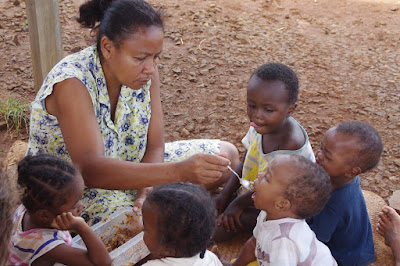
This April I had the awesome opportunity to work at an orphanage, La Maison d'Arnaud, in northern Madagascar. As part of a site-exchange*, I and two other Volunteers (one third-year education Volunteer who lives at the orphanage and one health Volunteer from my Peace Corps entry group) facilitated a week of health-related activities with the children and staff!
A nutrition cooking demonstration was our first activity on the week's menu. First, we made our own peanut butter with the Malagasy orphanage cooks and nannies, then mashed some sweet bananas into it. We got to feed it to the babies for morning snack, and they went BONKERS for that stuff. One baby actually cried when we ran out of it! Then with enough vegetables to feed a small elephant, we went on to make a hearty, nutrient-rich soup. If you don't believe kids like eating vegetables, then you wouldn't have believed your eyes to see the kids slurpin' up this soup at lunch. But they did enjoy it, and so did the staff! (Shout out to my Volunteer friend Jenna, who was the mastermind behind our cooking plan).


Monday, April 25, 2016
Stomping Out Malaria in Madagascar!

Shaking. Chills. Vomiting. Sweating. Aching.
It's anything but fun. It's painful. It damages your body. It can even kill you. It's malaria: the world's buzz kill.
Malaria cases and deaths are prevalent in multiple regions of the world. Just in 2015, there were about 214 million malaria cases and 438,000 deaths throughout the globe. However, while malaria can be devastating, it is also completely preventable! One day, it can be totally eradicated. So as part of the global effort to eradicate malaria through education and resources, April is designated as World Malaria Month and April 25th (today!) is World Malaria Day.
In accordance with World Malaria Month, I and two other Peace Corps Volunteers facilitated a malaria training over two days at a women's prison in Madagascar. In our training we discussed malaria symptoms, science, and prevention methods. All the women participated with excitement and especially had fun acting out how malaria is transmitted! On the second day, we hung bed nets for all the women in the dormitory, which is one of the most practical and effective methods for malaria prevention. The women created a great atmosphere with their enthusiasm and energy during the activities. In the end, we had 40 women empowered to stomp out malaria with their new prevention education and resources!
Subscribe to:
Posts (Atom)